
BLOCKCHAIN REGULATORY CERTAINTY ACT
The Blockchain Regulatory Certainty Act (BRCA):
Implications for Innovation, Regulation, and Regulated Financial Institutions
Krista Emmett, President of Convergence Strategies, a Washington-based strategy firm supporting investors, companies, and institutions in navigating U.S. public policy and regulatory strategy across complex industries, and a trusted advisor to Blockchain Integrated Partners.
The Blockchain Regulatory Certainty Act (BRCA), introduced in the 119th Congress as H.R. 3533 in the House and as a bipartisan companion bill in the Senate on January 12, 2026, represents a targeted, risk-based modernization of U.S. digital asset policy. Sponsored in the House by Representative Tom Emmer (R-MN) and Representative Ritchie Torres (D-NY) and led in the Senate by Senator Cynthia Lummis (R-WY) and Senator Ron Wyden (D-OR), BRCA is a regulatory-clarification statute, not a deregulatory one.
At its core, BRCA draws a clear legal boundary between:
-
Custodial financial institutions that control consumer funds, and
-
Non-custodial blockchain software and infrastructure providers that merely build or maintain technological rails.
The Act would establish that blockchain developers and service providers who do not have custody or control of user digital assets may not be treated as money transmitters or financial institutions under federal or state law solely due to their role in facilitating blockchain networks.
This clarification produces two simultaneous policy outcomes:
-
Protection of non-custodial software innovation, including open-source development and decentralized infrastructure; and
-
Preservation and reinforcement of regulated financial institutions, including banks and local credit unions, as the lawful custodians of customer assets and primary AML/consumer-protection gatekeepers.
For regulated institutions, particularly community-based and local credit unions, the impact would be indirect but strategically significant:
-
Regulatory obligations remain unchanged
-
Custodial authority is reinforced, not diminished
-
Compliance investments retain value
-
Safer pathways to adopt blockchain infrastructure emerge
BRCA modernizes financial infrastructure without eroding regulatory integrity.

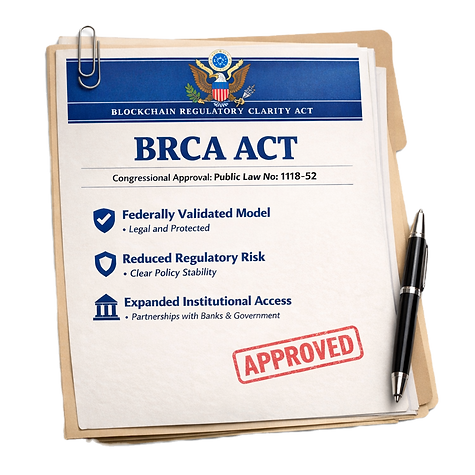
What this means for bip
BRCA is excellent news for Blockchain Integrated Partners because it:
-
Confirms BIP’s model as lawful and protected
-
Reduces existential regulatory risk
-
Expands partnerships with banks, credit unions, and government
-
Aligns federal policy with BIP’s architecture and values.
BRCA validates BIP as exactly the kind of company Congress wants building U.S. blockchain infrastructure.
Direct legal impact on regulated financial institutions and credit unions
No Change to Existing Obligations
Local credit unions and banks:
● Remain financial institutions under the Bank Secrecy Act
● Retain full AML, KYC, SAR, and consumer-protection duties
● Continue oversight by NCUA, FinCEN, state regulators, and federal banking agencies.
BRCA does not exempt custodians, weaken oversight, or alter compliance obligations.
Custody Remains the Regulatory Trigger
Because credit unions:
● Hold deposits
● Control customer funds
● Execute transactions on behalf of members
They fall outside the BRCA safe harbor by design. This preserves the integrity of the regulated financial system.
Indirect but strategic benefits for credit unions
Reinforcement of the Custodial Privilege:
By clarifying that non-custodial software firms are not financial institutions, BRCA:
-
Reinforces custody as a regulated function
-
Prevents “shadow banking” via software
-
Confirms that compliance investments remain meaningful
Credit unions are not displaced; their role is strengthened.
Reduced Vendor and Partnership Risk
BRCA lowers uncertainty when credit unions partner with:
-
Blockchain infrastructure provider
-
Distributed-ledger payment rail
-
Analytics, monitoring, andcompliance-tool vendors
Clear classification reduces:
-
Indirect liability concerns
-
Due-diligence complexity
-
Innovation hesitation
Safer Innovation Pathways
BRCA enables functional separation:
-
Software providers build rails
-
Credit unions provide custody, compliance, and consumer protection
This supports:
-
Tokenized payments
-
Regulated on-/off-ramps
-
Stablecoin settlement models
-
Cooperative blockchain pilots
Market-structure and competitive effects
BRCA:
-
Does not authorize software firms to act as banks
-
Does not permit custody without regulation
-
Does not erode deposit-taking authority
Instead, it:
-
Re-anchors financial intermediation in regulated institutions
-
Encourages modular, interoperable infrastructure
-
Benefits community-based institutions navigating technological change
Trust, compliance, and lawful custody remain central.
AML, consumer protection, and enforcement
BRCA does not:
-
Reduce AML obligations
-
Shield custodians from enforcement
-
Limit sanctions, fraud, or illicit-finance actions
By clarifying who is not a financial institution, BRCA may:
-
Improve enforcement focus
-
Reduce compliance noise
-
Strengthen accountability where custody exists